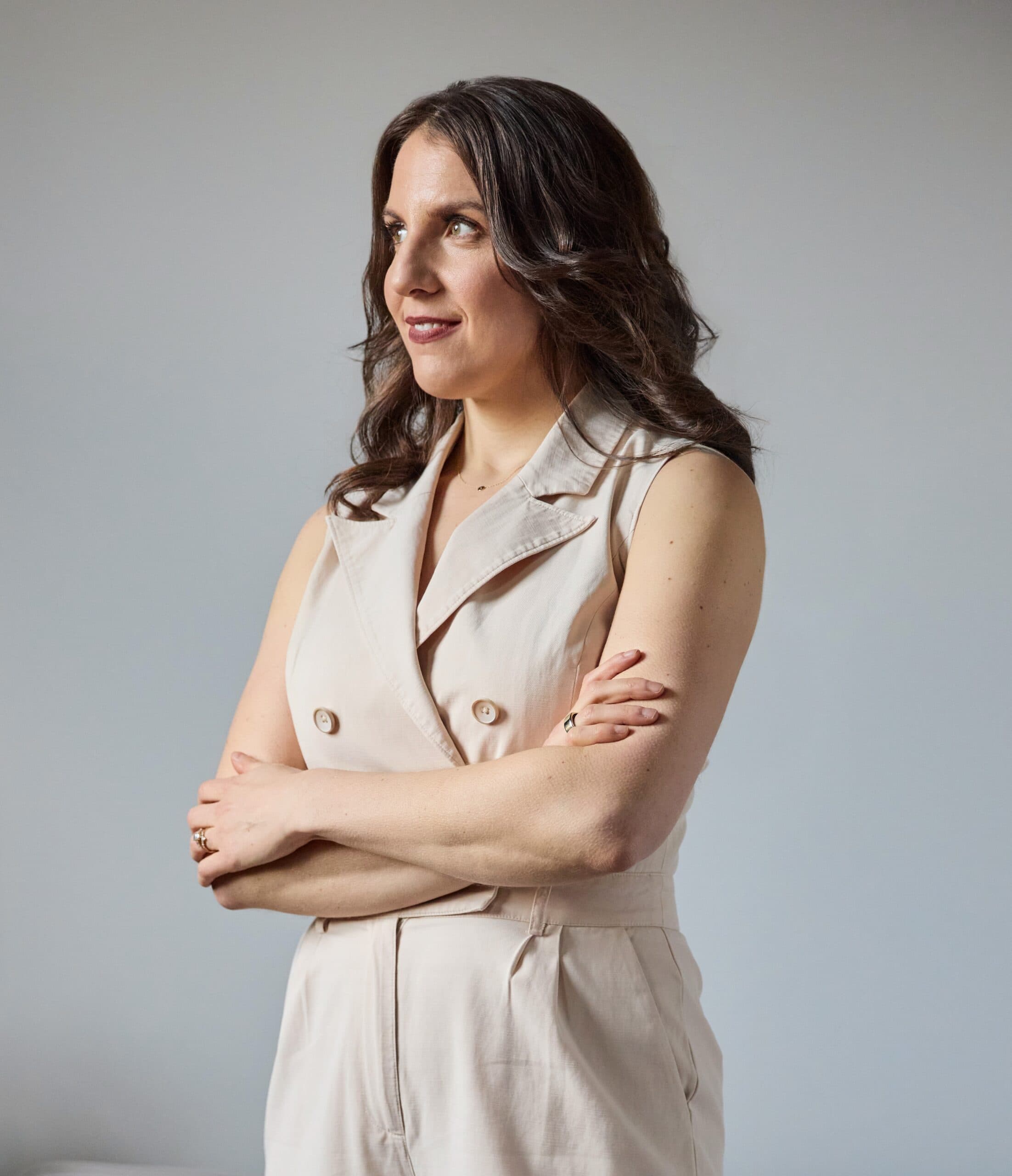
Melody Wilding (Intro):
How do you become fully confident and in control of your emotions and experience at work? It’s by mastering your own psychology and that of others. On this show, we decode the science of success, exploring how to get out of your own way and advance your career to new levels without becoming someone you’re not.
I’m Melody Wilding, bestselling author, human behavior professor, and award-winning executive coach. Get ready, and let’s put psychology to work for you.
I spend a huge portion of my work life on Zoom, which means I am constantly thinking about how to hold people’s attention, communicate with energy, come across with the same oomph that I may have in person. And maybe you’re in the same boat, knowing that something you want to improve at is being compelling even from afar.
You might not be co-located with your colleagues. Maybe you manage a distributed team, or you work with clients and partners across the globe. No matter the case, your virtual presence matters a lot. But showing up well on camera, it can feel pretty unnatural.
You may notice yourself sounding flat, relying too heavily on your notes, not knowing where on the screen to look, overthinking your expressions, and wondering whether anyone is even listening on the other side. All of this is why I’m so excited to welcome Karen Reed onto the show today. She is an Emmy award-winning journalist turned leadership communications expert and the CEO of Speaker Dynamics.
She’s going to teach you how to project more confidence and authority on camera, and she knows a thing or two about this because she began her career primarily working for NBC. She shook hands with US presidents, interviewed celebrities like Muhammad Ali, and garnered many awards for her work along the way.
So in this conversation, we get very practical and tactical about everything from how do you make eye contact on Zoom, how do you keep people engaged even when they have their cameras off, sound less scripted, use slides without letting them take over, and how to handle interruptions from senior leaders without getting derailed.
All right, let’s get into it.
Melody Wilding:
Karen, welcome to Psychology at Work. I am so over the moon to have you here, so thank you so much for taking the time to join me.
Karin Reed:
Melody, this is completely my pleasure. Thank you so much for having me on.
Melody Wilding:
Yes, and I was on your show, so I thank you for having me as a guest. And after we got done recording, I said, “I would love to have you on my show,” because you have such a fascinating background as a broadcast journalist, and now your entire career is teaching executives and corporations, doing tons of training worldwide to help people have virtual charisma and on-camera presence, which could not be more perfect for our audience here of folks who are, yes, many in corporate or nonprofit or who are in the work world, yet are on camera constantly with distributed teams, with their clients for conferences that they may even have to speak at, or panels that they are on, yet they have zero training in on-camera presence. Before we get into all your tips and tricks, ’cause I know you got them, tell us about how you started your career, because I think this is such a fascinating story, and I wanna hear what it taught you, how it brought you to doing this work today.
Karin Reed:
Yeah, it was kind of a crazy evolution because I began, as you mentioned, as a broadcast journalist and worked primarily for NBC and interviewed everybody from presidents to Muhammad Ali, and had a great career doing that and enjoyed it thoroughly, won awards along the way. But I did decide to leave the business to work in the corporate world, and I was brought in typically as the professional on-camera spokesperson.
But more and more often, I was noticing that they were bringing people in from the corner office or the corner cubicle to appear on camera alongside of me. That often did not go well. So I saw a business opportunity to help business professionals be better on-camera communicators. So that was well before Zoom became a household name, and it did quickly expand.
So I help people speak with ease across any platform, so that could be on camera, but it’s also in person as well as through virtual communication tools, and it’s that last one that you mentioned that became mission critical for so many of us around 2020. And that’s when things really started to shift because I went from being asked to train the executive leadership team to, “Can you train the entire enterprise?”
And I’m like, “Wow, that’s a lot of workshops.” So I had to figure out a way to scale, but everybody needed to suddenly be really effective speaking through a camera, which is something that I had been doing for decades and felt very comfortable doing, but the vast majority of the world did not. So it was kind of like being a 10-year overnight success because I had been teaching these on-camera communication skills for so long that it was really kind of a niche sort of thing, but then it became important to the vast majority of the world.
So it’s been really a privilege to be in a position where I could say, “Hey, I can help you. I have a proven methodology that we’ve been using for years. Let me just kind of unlock the door on how to make this work.”
Melody Wilding:
Gosh, what a great example of talent sort of colliding with the needs of the market at a great time, and I’m so excited for you that it has just taken off like that because it is so needed right now, as you said. Those who are in the corporate world do not get any of this exposure. And I’m wondering if you could give the person listening a little bit of a to help them understand what are the most common mistakes you saw even in your journalism work when you were interviewing those executives, the corner office people, and they were kind of fumbling it. Or even now in your training, do you see doing that they shouldn’t be doing? Because the person listening, and I even know for my case, there have been times in my career where I thought, “Yeah, I’m pretty good on camera,” and I was not at all. So I think it might help the person listening to have some sort of a baseline to assess themself against.
Karin Reed:
Okay. Well, first of all, I think you’re probably being hard on yourself because that is one of the most common things I see. People are so critical of how they are showing up on camera and, you know, just to… And they, and we also see things like nobody else sees. So I was working with a client and we, this was actually before it was virtual, virtual, virtual.
I was doing on-camera communication training, and I always would do a baseline presentation and then we’d go through the training and we’d do a post-training presentation on camera. And I was watching her post-training video and she did so well and I was so excited for her. And my back was to her at the time and I turned around and I said, “So what did you think?”
And she said, “My left eyebrow is higher than my right eyebrow.” I’m like, “What are you talking about? Nobody is noticing your eyebrows.” So the things that we pick up are not noticed by the vast majority of the world. But I would say the biggest thing that people struggle with is getting past the idea that they have to be performing and be perfect in that performance.
Because this environment that a virtual communication platform creates is actually pretty intimate. It’s not like you are standing up in front of the room and you’re projecting to the entire audience. It should feel more like you’re just having a conversation with somebody across the dinner table, and that conversation needs to be authentic.
Authenticity is what works best whenever you’re communicating virtually, so just you being you. But we get in our own heads and we can’t get that authentic self to come out. So it’s a matter of considering what kind of conversation you’re having. It’s not a big conversation. It’s a pretty small conversation.
You’re as close to your audience as your eyes to your webcam and their screen to their eyes. So if you translate that into an in-person conversation, you’re only just a couple feet away from somebody. So you’re not gonna project your voice and you’re not gonna do big gestures, and you’re also gonna be making good eye contact with them typically.
And when I think about the number one mistake that people make from just a straight up performance standpoint, it’s eye contact. That is the one that I see them miss on every single time.
Melody Wilding:
Let’s talk about that because this is something I certainly have had to train myself into, and I lapse on it many times. We’re recording this on video. The people listening cannot see that, but I’m looking into my camera lens. I’m not looking at you on the screen, which is tough. And what people have, clients have told me is, “Yeah, I understand. I do wanna connect with the audience, which is why I then end up looking at my screen and talking to them on the screen, but then I know I’m not making eye contact.” So tell us, how do we reconcile these things to get that connection, to make that work, but maybe make it feel more natural on our end? What do we do?
Karin Reed:
There are certain, I would call them rules of eye contact when it comes to virtual communication, and you’re hitting the nail on the head whenever you’re saying, “I wanna look at the screen because I wanna see my audience’s faces, and I wanna be able to read their non-verbals.” And of course we do. That’s what we do as human beings. We seek out that eye contact, and when we do it in a virtual setting, due to the limitations of today’s technology, we often do the exact opposite of that because we’re looking at the screen, and we are looking like we’re looking down. Sometimes depending upon where people have their cameras, it might appear that you’re looking off into the distance ’cause your camera’s on a separate monitor.
So it ends up looking really goofy. And here’s the thing, there are so many examples of how engagement decreases whenever you’re not looking into the camera lens. I will give you a quick anecdote, and then I will reveal the rules of eye contact, at least according to me. So I was working with a financial institution, and they had these ATMs that they were introducing where they were having virtual tellers pop up on the screen.
So if you imagine you go up to an ATM, and typically you just see words. Instead, what they wanted to do was see if they could recreate, in a virtual sense, what it would feel like to walk into a branch. So people would go to the ATM, they’d begin the process, and a person would come up and say, “Hi, Mr. Reed, how are you?” And what they were finding is that those who were using the ATM were not engaging with the virtual teller whatsoever. And what I noticed is the virtual tellers were not looking at the camera. They were looking down. They were looking at what they felt comfortable to them.
And I said, “Hey, try this. Let’s see if they can engage with the camera instead and see what happens.” And lo and behold, when they just shifted their eye contact to the camera lens and started addressing their customers by looking into the camera lens, suddenly the customer started talking back to them.
And when they did, the MPS scores, the satisfaction scores, they found that those went up dramatically as well. So the level of engagement that occurs whenever you do engage with the camera itself is huge. The camera is the de facto eyes of the person you’re conversing with. So here’s what I recommend, because I do hear you when you’re like, “I need to see my people.”
You don’t want to be staring into the camera lens like you are in a hostage video. That looks unnatural. But you want to think about how you can pour your energy through that camera. So if you are speaking, you want to primarily be looking at the camera lens, and you’re going to underline that primarily, because once again, you’re not going to stare at it nonstop.
Think about if you’re talking to somebody face-to-face. You don’t stare at them nonstop because it’s like you’re boring a hole in their brains. You want to look away because that’s natural. And when you look away, when you take those little split-second moments to look away, what can you do? You can check out what’s going on on the screen.
You can quickly ascertain if somebody is, like you’re doing right now, Melody, nodding your head. You can tell if somebody is completely disengaged and staring off into space. I don’t need to stare at your face like this, Melody. I’m going to look right now and wait for you to nod. I can capture that in that split second when I look away.
But the loss of engagement by not looking into the camera is too great. You don’t want to sacrifice that. It’s hard. It’s frustrating, and I get it, but it is such an important piece.
Melody Wilding:
Yeah. But I think that’s an important metric to aim for is not perfection, it’s not just fixated and oh my gosh, if I take my eyes off of that, I’ve lost it. But it’s to have more of that — this should be sort of your center of focus, but you can at your slides, you can say, “Oh, I’m gonna check in with the chat,” right? And that sort of gives you permission to also look away and engage with that as well. So I love that idea of just aim for most of the time.
Karin Reed:
Yeah. The camera’s the conduit to your conversation partner. There’s no other way to reach them.
I used to work for a client where I was their news anchor, and I’m gonna say that in quotes because it was for a company, and we would do these webcasts. And I had a director who was a Pittsburgh Steelers fan. I am from Pittsburgh originally, so I can talk about the Steelers ad nauseam. And before we would do the webcast, I would always engage in conversation with him by looking into the camera that was in front of me, because I knew he was somewhere in the building in master control looking at my giant face on a screen in front of him.
So what that did, by having that casual conversation beforehand, it got me into that conversation space, and it also allowed me to visualize a viewer. Think about somebody who was on the other side. So that is also a really critical piece, just thinking about who is on the other side of you, who is receiving your message, and how you can react to the way you’re hoping they’re reacting.
I always think about my viewer as being somebody who is liking what I’m saying, not somebody who’s throwing up all sorts of obstacles. And I literally envision that, and that allows that animation that would normally be in your face when you’re talking to them face-to-face to actually appear when you’re virtual.
Melody Wilding:
I’m really glad you brought that up, and I wanna underscore that this is a tip for everyone of imagining the receptive, excited person on the other side because I think we’ve all had that experience where you’re presenting to a Zoom room and no one has their cameras on, you just feel like you’re talking into the abyss. Even clients will say to me, and I’m sure you’ve heard this a million times, “I’m not getting any feedback, and if I present in person in a conference room even, at least I can see and I get some real-time reactions from people.” So do you have any other suggestions for someone who finds themselves in that situation where it’s just the Brady Bunch boxes with no faces? What do you do in that case? How do you keep your own up and not start getting in your own head?
Karin Reed:
Yeah, and I do hear that all the time, Melody. And there are a couple of different things that I would suggest. Okay, the first thing I’d suggest is see if you can get anybody to turn their camera on. So I always, if possible, will make a small ask at the beginning of whatever meeting I’m in and say, “Hey, one of the things I just miss in this environment is seeing people’s faces. So if you don’t mind, if you’re able, if you can just turn your camera on briefly just so I can put a face with a name, great. If you wanna turn it back off, it’s completely fine.” But I do find mostly that’s almost like ripping off the bandage. Once they turn it on, they’ll keep it on. And that gives you somebody to play off of.
Even if it’s one person in the room, it’s helpful, right? But if that is not the case, what I am typically gonna be doing is leaning in more to those audio check-ins. So I am going to want to ensure that people are actually still there. So when I deliver something virtually, I’m never just gonna talk at people for 30 minutes straight, because then it does genuinely feel like you’re talking to nobody.
I am gonna be breaking things up into digestible chunks. I’m gonna be pausing. Maybe I’m gonna throw out a question that I want them to answer in chat. If that is available to me, I’m gonna do that, and I will sit in that silence and wait for them to respond in chat before I move on. And maybe I’m not silent the entire time. Maybe I’m giving some ideas about how they might answer that question, but I’m gonna wait for people to do something. Because when you’re in a virtual setting, one of the biggest things that you’re fighting is the default position most people wanna take of passive observer. It’s how we’ve been conditioned to engage with screens.
We watch TV. We watch a movie. But now we want people to be active participants through a screen, and that can be hard to get them off the default position. So I’m always thinking of ways to have them do something throughout a workshop, throughout a webinar, throughout a meeting. And that can take a variety of different forms, whether it’s full-on I’m gonna stop and I’m gonna have Q&A, or it can be put something in chat.
For example, I’ll do something where I’ll say, “Come on camera. How many seconds do you think that pause was?” And I’ll have people raise their fingers. And just to get them to do things so that they feel like they are reengaging on a regular basis. My co-author for three of my books is Dr. Joe Allen. He is the leading meeting scientist in the world, literally, and he’s given me so many tips and tricks. And one of the things that he suggests and that he adopted after COVID and everything went virtual, is he moved from doing 45-minute in-person lectures to seven-minute lecturettes.
So he’d do seven minutes of content, and then he’d have deep discussion, and another seven minutes of content and deep discussion. And he found that it was a much more satisfying experience for his students as well as for him. So I would adopt that in your own meetings. Allow yourself to break things up and you’ll keep people focused on the task at hand and not let them wander off somewhere or be distracted by what’s out the window.
Melody Wilding:
Yeah. Yeah, because when someone is virtual, there are so many more temptations. You don’t have them trapped in a conference room or a boardroom where they are looking at you. They have their phone right next to them, their spouse or dog may come in. There’s abundance of distractions is great, so I love that idea of thinking about it as more micro sections or even having… Sometimes I find even just, “Hey, give me a thumbs up if you agree with this.” Right? Just as simple, make the action painfully easy and simple for people to complete, and it just ensures they’re paying more attention than they might otherwise. Yeah.
Karin Reed:
And it helps you too, right? Because you’re like, “Oh, people are there and they are listening to what I’m saying.” So it’s a boost of confidence as well.
Melody Wilding:
Right. Right. Now, we’ve been talking a lot about coming off more charismatic, authentic, more natural on camera. Something I notice with virtual presentations when I’m coaching people through that or reviewing what people have done is there is a tendency to rely more on your script. How can we avoid coming off sounding flat, overly scripted and stilted when we are presenting virtually? Because I think it’s much easier to come across more robotic when we’re doing it this way.
Karin Reed:
Step one, get rid of the script. So that seems kind of flippant, but it’s true. I mean, think about it. This is a conversation space. This is not really a performance space. You know, there’s of course performative aspects to it. One of the things I teach is the MVPs of performance success, which is mental mindset, vocal variety, and physical factors.
But it really is more about your delivery as opposed to a performance per se. So when you’re using a script, no matter how good you are at reading, it will be easily detectable that you are indeed reading, and you will sound less like you. So what I suggest is if you wanna just try to get a feel for the flow of your presentation, write it out. That’s completely fine. But you wanna reduce it to bullets, and not fake bullets. I’ve seen this too, I don’t know if you have, Melody, where people are like, “Yeah, I have it in bullets.” No, actually, you just put a bullet in front of each of your sentences. Like that’s not bullets. They need to be actual phrases, right?
So if you reduce it down to bullets, it will allow you to stay on track with hitting the key points that you want to, but you also need to give yourself the freedom to communicate the words that come to you in the moment. And I always have people say to me, “Oh, you’re so polished when you’re on camera.” I’m like, “I’m not. I’m really not polished.” I mess up syntax all the time. I kick words. But I am myself. If you would meet me in person, I’m the exact same person as you see right here. And I think that’s what resonates with an audience. But you have to have faith in your ability to speak your expertise.
So you have to prepare. You have to know what you’re talking about. But then just allow yourself the freedom to communicate that in a much more free-flowing manner than if you’re just reading off a script, because that is gonna just sound so inauthentic, and that’s gonna come across as fake. Nobody likes fake. So let that go and allow yourself to just speak as you would if you were presenting in person. And if you’re presenting in front of a room, imagine this. You’ve got your slides behind you. Think about if somebody would pick up a sheet of paper and start reading off of that sheet of paper standing up in front of the room.
Nobody would do that ’cause it would look terrible. So translate that into the virtual. How would you be doing it virtually? Well, you’d probably have a couple of notes to remind you of certain things. I tend to use my slides as a way to jog my memory about what I wanna say next, and I think that is a much better approach, especially in this environment, to allow yourself to come across as authoritative yet authentic.
Melody Wilding:
Yes. Yeah, this is such a great balance to strike between preparation and overpreparation. Because I have had people who do that, where every sentence, “But I have the bullets.” And the other problem with that too is, if you are interrupted, or you see a comment, or someone raises their hand, then you get off script, you’re really at a loss. So we don’t wanna be so rigid. Your point, actually one thing I personally really like about virtual is it’s easier for me to time keep myself on track than in person, where the clock may not be as visible or how long I’ve spent on a certain slide is not as visible. So it’s actually easier for me to catch myself if I might be rambling too long on one slide and say, “Okay, I’ll pause there and move on to this next one.” That is one advantage of virtual in my opinion.
Karin Reed:
Oh, yeah. You can use a lot of things virtually that you can’t whenever you’re in person. I mean, I always think about how you have two realities. You have the one that’s on camera and the one that’s off camera, and if you could see my desk, Melody, you would see papers everywhere. I keep sticky notes on my monitor to remind me to do certain things, and you can’t do that when you’re in person, but it is a great advantage whenever you’re doing virtual presentations.
But I feel like sometimes people over-index on that, and they’re like, “I have all of this,” what I would call hidden real estate to hide my notes. But if you’re reading off your notes, you’re not hiding anything.
Melody Wilding:
Yes. Now, we touched a little bit on your slide structure and construction, and it’s good to hear, it’s reassuring to hear you use slides because sometimes you will hear people that are, “No slides, it takes away from the connection.” So I’m glad to hear that because the 99% of the people listening have to present with slides, data or they’re required to for whatever reason. They have to send those slides around afterwards. Any recommendations for, yes, we know you’ve mentioned don’t overload all of your sentences onto the slide, but are there any other key differences we should keep in mind between an in-person and a virtual presentation in terms of how we’re constructing our deck?
Karin Reed:
Yeah, I have oodles of recommendations for this, but I’ll hit some of the top ones. And the big thing to remember is when you’re in a virtual environment, there is an imbalance of power between your slides and you. Because if you imagine if you’re in person, you are kind of the star of the show, right? You’re standing in front of your slides typically, and you can use them to support you. You know, maybe you turn around and refer to bullet one, two or three, whatever it is. But you’re interacting primarily with the audience, and you are the main purveyor of information. The slides support you.
They do not become the show. That can flip whenever you’re virtual because with today’s technology, what takes up the majority of the screen space when you’re sharing your slides? The slides. And they become the be-all, end-all. And if you have so much stuff on your slide, the text on the screen is gonna have such a strong gravitational pull, people will be drawn to it and they will start reading.
And when they start reading, what happens? They turn their ears off to you, and suddenly you’ve been minimized in your role in that particular presentation. So I always like to think about is my slide serving me or is it not serving me? So just a basic premise that I like to pass along to folks is if you are using slides, perhaps initially that slide is helping to impart information.
And I do agree with using slides, Melody, too, because I do feel like you have to pay attention to the fact that the majority of us are visual learners. And if you don’t have some visual to anchor them to what you are saying, you’re doing them a disservice. So I am a fan of using slides that have the key points on it.
But at some point, maybe that slide is no longer imparting information, and at that point it becomes a resting spot for the eyes of your audience, and they start to zone out. So what I like to do, if that’s the case, is take that slide away, and I’m gonna come back onto gallery view. At a minimum, I’m gonna be on camera, and perhaps if other people have turned their cameras on as well, then they’ll see themselves on the screen as well.
And it almost jogs their memory that, “Oh, I’m in a call. I need to actually be paying attention.” And it reengages them by default. So it also creates a more typical conversation space, because you can suddenly see people’s faces. You can better read the room. You can’t read the room if you’re sharing your slides. It’s just either people completely disappear, depending on the platform, or maybe you’ve got one person in the corner. And you wanna be able to proactively draw out participation. So for example, if I ask a question, I’m never gonna ask a question when I’m sharing my slides because either no one will respond or people will talk at once, and neither of these are productive.
So I want to be a conversation traffic cop, which means I’m gonna proactively call on them by name. So if somebody leans towards the camera, that’s usually a precursor to them wanting to say something. So I’ll be like, “Hey, Bob, looks like you have something to say.” If somebody unmutes themselves, that’s also a signal that they want to enter into the conversation space, and I’ll call on them before they even utter a word.
And I have had situations where somebody will be like, “No, I actually have nothing to say.” I’m like, “That’s fine. I’d rather give you an opportunity to weigh in than miss out on that chance for them to participate.” But one of the biggest challenges that I see in virtual is that stunted, stilted conversation that you’re talking about, and it’s because people don’t know when it’s their turn to have the floor.
And so as a meeting leader, you need to be really proactive in calling that out and pulling that out, and using their name is a great way to do that, provided that you’ve done it in a psychologically safe way.
Melody Wilding:
Yes. Okay, building off of that, this is fantastic. I think it’s great to think of yourself almost as the facilitator of the space and the conversation, again, rather than just the performer who is delivering information, just a different stance. Sometimes the folks who are listening may be in situations where they’re presenting to leadership, the C-suite, the board, high-level customers who are much more willing to jump in and start asking a question or talk over you. What do you do in that? What do you recommend when you’re in that situation? You’re in the middle of presenting and someone says, “Well, actually, I’d like to know, did we consider blah, blah, blah?” How do you direct that?
Karin Reed:
I know that executive that you just mimicked.
Melody Wilding:
Exactly. We all know them.
Karin Reed:
Right. Exactly. So what I suggest is thinking about those interruptions not as your time when you need to stop and take a left turn, completely change the course of your conversation. Instead, think about it as a speed bump, where you might have to slow down, but you’re still continuing to tell the story that you wanna tell.
The other metaphor I give is like holding a speaking baton. When you’re presenting, you’re holding a speaking baton. There might be times where you need to share the speaking baton. So say that executive is like, “Hey, have you thought about what would happen if we would do this?” Maybe you’re holding onto that speaking baton together, but you are not letting go.
Because if you let go, that executive’s gonna run completely in the wrong direction and they’re gonna completely take over the conversation and you’ve lost control of the ability to deliver the message that you need to deliver for them. And oftentimes, here’s the funny thing, those people who are interrupting you, they’re relying upon you to provide the information so they can make a good business decision.
But sometimes they fight you. And you’re like, “You’re not helping your cause. I have to get this message out in full, but you keep on interrupting me and not allowing me to share it with you.” So I would suggest a technique called paraphrase and pivot. So say this person interrupts you, you have to be deferential to some degree to respect their title, right?
So you can’t just be like, “Stop talking, I’m talking.” That would be rude and wrong. But you can allow them to ask the question or to make the comment, but when they come up for air, when there’s a sliver of space, that’s when you can say, “Hey, I’m so glad you brought up that point, and that’s actually something I’m going to be talking about in about five minutes. So if you don’t mind, can I just wrap up my thoughts here?” And then continue speaking the way you wanted to speak and continue down your trajectory. And that is a way to show them respect, acknowledge their point, acknowledge their question, and maybe you encapsulate what they’ve said.
“Yeah, I hear you that you’re worried about what’s gonna happen in Q3 with this particular product, and we’re actually gonna talk about that in about five minutes. But right now, let me finish what’s going on in Q2 with this particular product.” And then you tell them. That’s one way you can do it. Or if you feel like you have to answer a question in the moment, answer it succinctly.
The mistake I often see people make is they’ll answer it very deeply, and then they’ve forfeited all the time allotted to their full message, and they never get their full message out. So you can answer it succinctly, and you can offer more later, which means that perhaps you’ll offer it more later in that particular session.
Or you can say, “Great point. I’d love to have a longer conversation about this, but we just don’t have the time here to do it. Can we have a one-off and talk about it separately?” And this is especially helpful if you’re in front of a whole team of senior leaders and you know this one person cares about this and nobody else does.
That’s the time when I’d be saying, “Hey, let’s take this offline and have another conversation, just the two of us. I agree it’s something that needs to be explored. We just don’t have the time for it here.” So that’s how I would handle that.
Melody Wilding:
Yeah. And it goes, to me, it goes back to that idea of you’re the facilitator of the space for everyone there. So before we get into our own head about, oh gosh, if I don’t answer this one executive’s question, also need to think about for the benefit of the time and the information that everyone needs there, it would be a disservice if you spent 20 minutes doing a deep dive on this one person’s question, then didn’t get to any of the rest of the agenda or slides you meant to. So I think that’s a good counterbalance because we can get really obsessed or distracted by, oh, I have to… This person asked this, now I’m derailed and have to tackle that.
Karin Reed:
And it also helps to separate intent from impact. Sometimes we consider those interruptions as a way just to derail us, and we’re really annoyed. It might actually be them wanting to learn more because they’re buying into what you’re saying, but they don’t have a whole lot of time to get to the answers that they need.
So those interruptions are just a way for them to get a shortcut to get the information that they need in order to make a decision. So it could be a sign of buy-in, not rejection. And if you have that positive intent in mind, it can help you reduce your frustration.
Melody Wilding:
That’s an excellent, excellent point, and in my program, Speak Like a Senior Leader, we talk about the different styles of communication that decision-makers may have. Our more dominant communication styles are more willing to jump in and say, “Okay, so what are you thinking about in terms of the rollout for this?” And to your point, to them, that is a form of engagement. You may, from your own lens, see it as really disrespectful that this person is now jumping in the middle of your presentation, but again, if we assume best intent, it is still a form of engagement. It may not be our preferred form of it, but I love this agency and the permission you are giving us to channel it in a better direction.
Karin Reed:
And it’s much worse if nobody says anything, Melody. Can you imagine? You get through your whole presentation, there’s no questions, no comments. You’re really in trouble.
Melody Wilding:
Exactly. Actually, let’s ask that. What do you do if you get to the end and you ask any questions, it’s crickets?
Karin Reed:
So I like to do something called cold calling with good intention. So hopefully you know who’s in your audience, you’ve done a little bit of audience analysis, and you know that there is one person who cares more about a particular thing that you presented. Maybe you call upon that person by name, because if they hear their name, they’ll perk up.
They know they have to respond, and be like, “Melody, I know you’ve had a lot of experience with this particular client. Based upon what I just presented, I’d love to get your opinion on it.” And that way you’re not putting them on the spot and asking them to produce facts, you’re just asking for their thoughts.
And once you get the ball rolling with one person speaking up, typically that will lead to more people speaking up.
Melody Wilding:
Yes, very true. Karen, thank you so much for being here, for sharing so many practical tips and all of your wisdom. Where do you wanna send people to connect with you further? Because this is the tip of the iceberg of the work you do.
Karin Reed:
Oh, thank you for the opportunity, Melody. So the best place to find all things Karen Reed and all things Speaker Dynamics, which is the company that I lead, is speakerdynamics.com. We have everything on there from the training that we offer to all of the resources that are available to you right now. And also you can check out the podcast that Melody was so gracious to appear on too.
Melody Wilding:
Excellent. Thank you so much.
Melody Wilding (Outro):
Thanks for tuning in to today’s episode of Psychology At Work. If you enjoyed the show, I’d be so grateful if you could take just a minute to rate and review wherever you are listening. It’s how we reach more professionals just like you. And if you’d like to see even more content on how to feel more self-assured, grounded, and in control of your emotions and reactions at work, follow me on LinkedIn or head to the links in the show notes.